
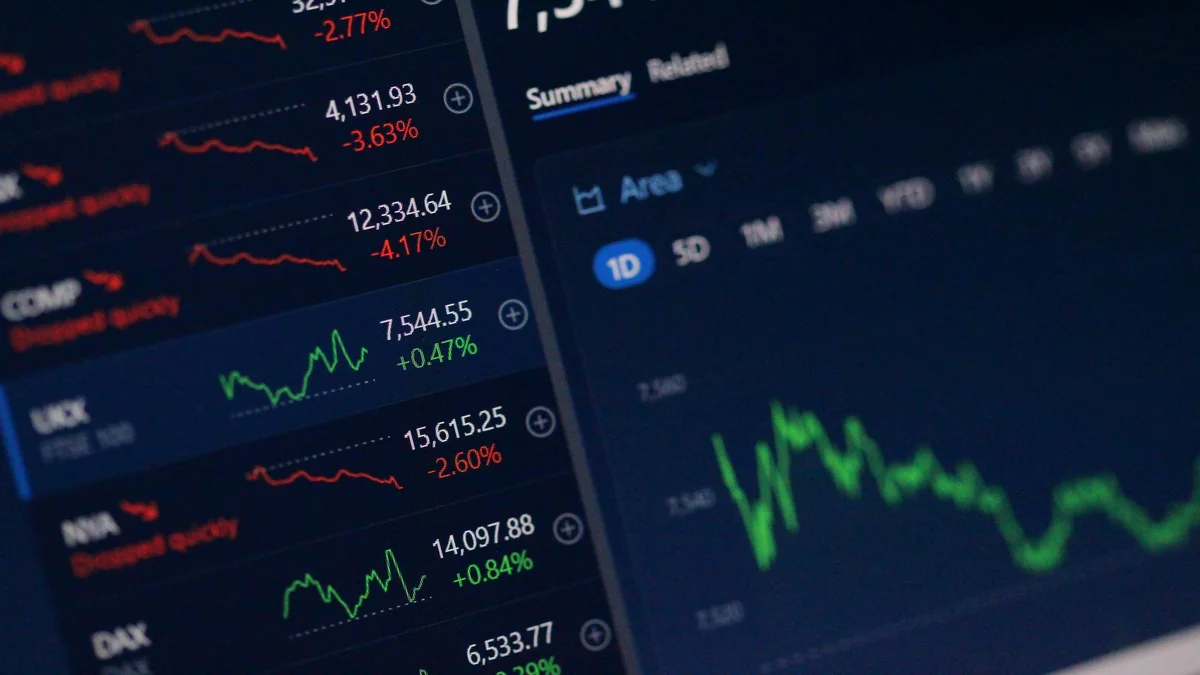
The global equity markets commenced 2026 with striking optimism, driven by a convergence of artificial intelligence enthusiasm, metal price rebounds, and milestone-breaking performance in key indices.
The FTSE 100's breach of the psychological 10,000 barrier symbolizes broader market confidence, while futures across the Atlantic signal sustained momentum despite recent volatility at year-end.
The FTSE 100 crossed the 10,000 threshold for the first time in its history on Friday, January 2, climbing approximately 0.7% at the market open. This achievement caps a remarkable 2025 for the UK benchmark, which gained more than 21%, marking its strongest annual performance since 2009.
The index significantly outperformed major US counterparts, including the tech-heavy Nasdaq, which rose 20%, and the S&P 500, which climbed 16% over the same period.
Mining stocks emerged as the primary drivers of UK gains on the opening day. Fresnillo, a precious metals producer, surged more than 5%, while broader commodities benefited from an overshooting precious metals complex.
This sectoral rotation reflects a fundamental shift in market dynamics—the outperformance of mature, dividend-yielding UK sectors, particularly mining and defense, offset weakness in other areas. The pound's weakness against major currencies has bolstered sterling revenues for multinationals, providing a structural tailwind that analysts expect to persist through 2026.
The Resurgence of Precious Metals
Precious metals extended their extraordinary 2025 performance into the new year. Gold posted its largest annual gain in 46 years, while silver and platinum achieved record gains, driven by multiple converging factors.
Spot gold advanced 0.9% to $4,351.70 per ounce, while silver jumped 2% to $72.63 per ounce in early January trading. Gold futures climbed approximately 1.5% to reach $4,410 per ounce.
Silver's outperformance proved particularly dramatic. The metal extended its extraordinary run, gaining another 10% on the week preceding the new year, pushing its year-to-date return to 118%.
The rally has been turbocharged by a powerful combination of factors: gold-led investor demand, decisive technical breakouts, and growing recognition of silver's industrial role—particularly in solar energy, electrification, and data-center infrastructure. While corrections from current levels remain likely, support remains firm amid robust industrial demand and tight physical market conditions.
The momentum in precious metals reflects deeper structural themes. Central bank diversification away from conventional currency reserves, combined with expectations of continued Federal Reserve rate cuts, has bolstered investment demand for hard assets.
These factors are expected to support metal prices throughout 2026, despite near-term upside limitations after the exceptional 2025 rally. Copper has also benefited from electrification themes and supply tightness, with concerns over US tariff policy creating additional volatility.
Futures Point to Continued Strength
US stock futures signaled a positive start to 2026, following the fourth consecutive session of declines at year-end 2025. Nasdaq 100 futures rose 1.1%, S&P 500 futures advanced 0.6%, and Dow Jones Industrial Average futures climbed 0.4%.
These gains were underpinned by a fresh burst of optimism around artificial intelligence, particularly following announcements from Asian tech companies.
Semiconductor and technology stocks led the market's charge. Baidu surged 11% before US market open, buoyed by news that its AI chip division had filed for an IPO in Hong Kong. Micron Technology, which skyrocketed 239% throughout 2025, climbed nearly 3% in early trading.
Palantir, which experienced a 135% increase in 2025, gained over 2%, while semiconductor giants advanced broadly. Tesla rose 1.5% to 2.3% in premarket trading, anticipating fourth-quarter delivery figures.
Europe's Stoxx 600 index hit an all-time high, advancing 0.8%, while Asian markets also participated in the rally. Hong Kong's Hang Seng surged 2.8%, and South Korea's Kospi closed up 2.3%, achieving new all-time highs.
Artificial Intelligence as the Dominant Market Narrative
Artificial intelligence investment and infrastructure spending have crystallized as the central narrative driving equity markets into 2026. Hyperscaler capital expenditures—from the Big Four (Meta, Microsoft, Alphabet, and Amazon)—are projected to exceed $300 billion in 2026 alone, with total hyperscaler capex reaching approximately $600 billion.
These investments target data center expansion, semiconductor procurement, and power generation infrastructure to support AI model development.
This phenomenon resembles transformational periods in economic history. Vanguard analysts have compared the current wave of AI-driven physical capital investment to previous paradigm shifts, such as the 19th-century railroad expansion and the late-1990s information and telecommunications surge.
The structural demand for electricity, semiconductors, and infrastructure provides multi-year tailwinds across industrial, energy, and technology sectors.
However, market participants increasingly demand clarity on return on capital from these investments. Concerns about whether the scale of spending will generate proportionate productivity improvements represent the primary downside risk to the consensus bullish outlook.
Should companies pull back on guided capital expenditures or if the market loses confidence in AI returns, analysts warn that stock market performance could deteriorate significantly from current expectations.
Central Bank Policy as a Supporting Force
The Federal Reserve's monetary policy stance has shifted to accommodation, providing tailwinds for equities and commodities. The Fed delivered three 25-basis-point rate cuts in 2025, moving policy from restrictive toward neutral territory.
However, the Fed signaled a more cautious approach for 2026, with median policymaker projections indicating only one rate cut next year.
Market expectations have diverged somewhat from official Fed guidance. While Goldman Sachs and other major institutions forecast two rate cuts in the first half of 2026 (in March and June), bringing rates to 3.0%-3.25%, this remains well above the ultra-accommodative levels of the pandemic era.
The Fed's shift toward data-dependent policy—emphasizing labor market resilience and elevated inflation—suggests that further cuts will depend on economic developments rather than a predetermined easing path.
This monetary policy backdrop proves constructive for equities but less dovish than some market participants anticipated.
The persistence of inflation above the Fed's 2% target, combined with relatively solid labor market conditions through the end of 2025, has constrained the central bank's appetite for aggressive easing.
Global Economic Foundation Supports Market Rally
Economists broadly expect resilient growth in 2026, providing fundamental support for the equity rally. Goldman Sachs forecasts global GDP growth of 2.8% next year, exceeding consensus expectations of 2.5%, with US growth reaching 2.6%.
Fiscal stimulus, particularly in the United States, Germany, and Japan, is expected to support demand and employment.
Corporate earnings provide additional support to the bullish case. S&P 500 earnings are projected to grow 15.5% in 2026, following a 13% increase in 2025. Notably, earnings growth is expected to broaden beyond the concentrated "Magnificent Seven" megacap cohort.
While these companies posted 37% profit growth in 2024 compared to 7% for the rest of the index, 2026 will see this disparity narrow: the Mag 7 are expected to grow 23% while the remaining 493 stocks are projected to grow 13%.
This broadening of earnings growth represents a significant shift. It suggests that fiscal stimulus, easier monetary conditions, and AI-driven productivity improvements are beginning to filter through mature industrial, financial, pharmaceutical, and consumer-facing sectors that comprise much of the FTSE 100.
For UK investors, the earnings resilience of multinational corporations and the structural efficiency gains from AI implementation provide a particularly compelling backdrop.
Risks and Uncertainties for 2026
Despite the broadly constructive setup, significant risks threaten consensus expectations. The valuation environment remains elevated, particularly for technology stocks.
The S&P 500 trades at approximately 25 times forward earnings, compared to the FTSE 100's 14 times earnings multiple, suggesting limited room for multiple expansion without corresponding earnings growth.
AI-related disappointment ranks as the primary risk to market performance. If companies experience delays in translating capital spending into productivity improvements, or if return-on-investment calculations prove disappointing, a significant market correction could occur.
This uncertainty is likely to intensify during 2026 as companies report whether capex investments are generating expected returns.
Trade policy represents an additional wildcard. President Trump's tariff announcements and their economic implications remain unclear, creating uncertainty that extends into the middle of 2026.
While tariff concerns have moderated relative to early 2025, the resolution of US-China trade tensions could act as either a substantial positive or negative catalyst.
Looking Forward
The markets' opening days of 2026 reflect a fundamental repricing toward cautious optimism.
The FTSE 100's conquest of 10,000 points, the rebound in precious metals, and the continued strength in technology and AI-related equities all point toward a year characterized by broadening participation, moderating volatility, and earnings-driven gains.
The technical structure of the FTSE 100 remains constructive, with support levels at 9,277–9,357 intact and a longer-term Fibonacci target of 11,405 representing approximately 14% additional upside from current levels.
For equities more broadly, the combination of accommodative monetary policy, fiscal support, AI investment, and broadening earnings growth creates an environment where weakness may be viewed as opportunity rather than warning.
Yet the year ahead will require sustained discipline from corporate management and honesty about AI investment returns.
The market's continued rally depends on whether the real economy delivers the productivity improvements that justify the historical investment levels now underway.