
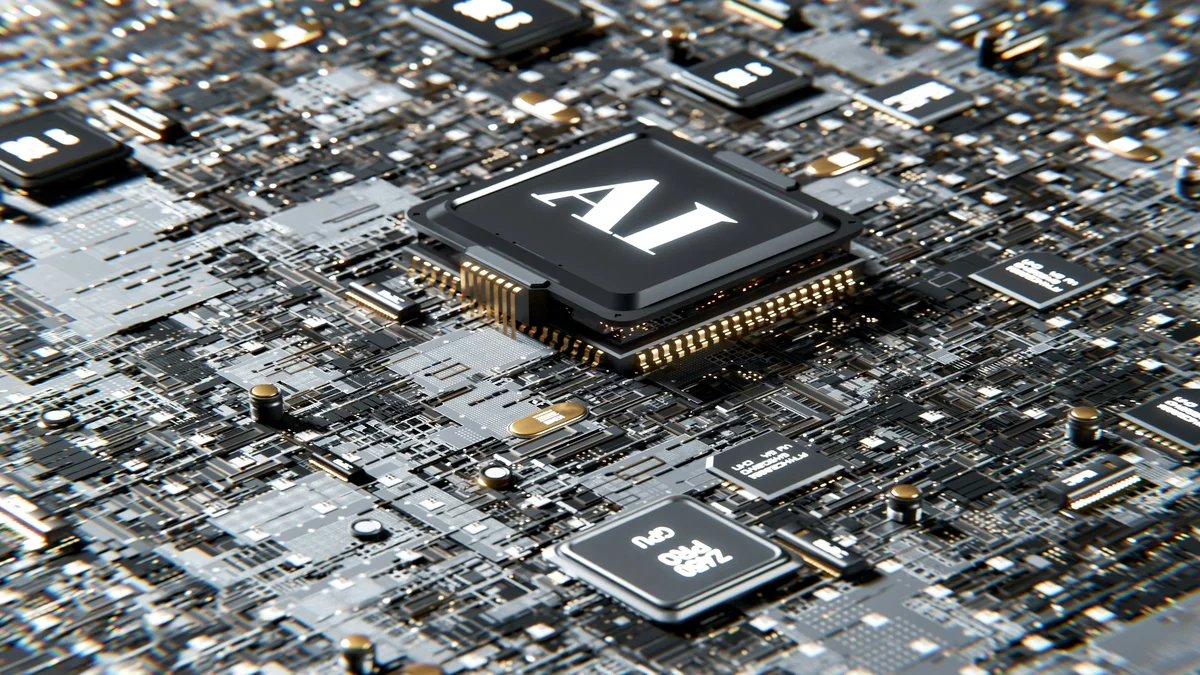
The artificial intelligence boom has created an unprecedented divergence between NVIDIA and Micron Technology. While both companies have benefited from the exponential growth in AI infrastructure spending, their competitive positions and growth trajectories entering 2026 reveal a critical insight: the company controlling memory supply, not just processing power, holds the upper hand in the semiconductor cycle ahead.
After surging 239% in 2025—more than six times NVIDIA's 38.8% gain—Micron has emerged as the more likely winner in 2026, driven by a structural supply shortage that gives it extraordinary pricing power and visibility.
The Memory Bottleneck Reshaping AI Infrastructure
For years, NVIDIA's dominance in GPU processing has seemed unshakeable. The company controls approximately 80% to 90% of the discrete GPU market for AI accelerators, with its CUDA ecosystem creating a network effect that competitors struggle to replicate.
However, a fundamental shift in AI infrastructure priorities is now favoring Micron.fortune
The explosive demand for high-bandwidth memory (HBM)—the specialized memory that sits at the core of AI accelerators—has created an acute supply crisis that extends far beyond typical cyclical shortages. During the first quarter of fiscal 2026, Micron reported revenues of $13.64 billion, reflecting a stunning 57% year-over-year increase.
More telling, the company's cloud memory segment alone generated $5.3 billion in revenue, doubling from the prior year. This is not mere growth; it reflects a fundamental tightening in an essential layer of AI infrastructure.ainvest
Micron's own guidance for the second quarter of fiscal 2026 projects revenues between $18.3 billion and $19.1 billion—a sequential surge that signals accelerating demand at a scale the memory industry has rarely witnessed.
Critically, the company has announced that its 2026 HBM supply is completely sold out, with orders already locked in at committed volumes and prices. This level of demand visibility is extraordinary in an industry historically plagued by cyclical inventory swings.finance.yahoo
The Structural Nature of Memory Scarcity
What distinguishes Micron's current position from past memory cycles is the structural—rather than temporary—nature of the supply shortage. Industry inventory has compressed from approximately 31 weeks at the start of 2025 to just eight weeks currently.
This is not slack inventory awaiting clearance; it reflects a genuine mismatch between the exponential scaling of AI data center capacity and the physical limits of HBM production.
The dynamics are particularly acute because of a production trade-off that Micron has deliberately engineered. The company is converting conventional DRAM capacity to HBM at a three-to-one ratio: each HBM4 chip produced forgoes the equivalent capacity of three standard DRAM chips.
This reallocation has simultaneously intensified the supply crunch for non-HBM markets while dramatically amplifying the scarcity—and pricing power—of Micron's advanced memory offerings.
Reflecting this supply tightness, Micron's operating margins have expanded to 47%—more than double the 27.5% recorded in the prior year.
This is not a modest improvement driven by operational efficiency; it is the financial signature of a market where supply is the binding constraint, and the supplier commands pricing power typically seen only in monopolistic or near-monopolistic conditions.
NVIDIA's Dual Challenge: Memory Lock-In and Inference Competition
NVIDIA remains the dominant force in GPU processing, with data center revenues that reached $47.5 billion in fiscal 2024, representing a 217% year-over-year surge.
However, the company now faces two converging challenges that complicate its 2026 outlook.
The first is memory dependency. NVIDIA's upcoming Rubin platform, expected to ship in the second half of 2026, will require substantial quantities of HBM4 memory. Yet the company's supply of this critical component is not assured.
While NVIDIA has pursued pre-booking strategies to lock in HBM4 allocation for Rubin's launch, Micron has already pre-sold its entire 2026 HBM capacity to customers outside NVIDIA. Competitors including AMD and custom accelerator users have also secured allocations. The practical consequence: NVIDIA must compete fiercely for Micron's output, and Micron sets the prices.cnn
The second challenge is architectural. NVIDIA's $20 billion licensing agreement with Groq for inference-optimized chip design signals a strategic vulnerability that the company is only now attempting to address.
The AI market is bifurcating: training large models remains GPU-dominated, but inference—the phase where models run in production to generate outputs—is rapidly becoming the dominant workload. Inference requires different optimization than training: lower latency, predictable performance, and energy efficiency matter more than raw throughput.cafetechinenglish.substack
Groq's inference-specialized LPU architecture promised (and demonstrated) capabilities that NVIDIA's general-purpose GPUs do not match. Rather than competing with Groq through organic R&D, NVIDIA chose to acquire the company's intellectual property and team through a licensing structure.
This is both a tactical win and a strategic admission: NVIDIA recognized that maintaining its near-monopolistic 80%+ GPU market share requires evolving beyond its current architecture, and the company preferred to license proven technology rather than build it internally.groq
The Competitive Reshuffling in AI Acceleration
The competitive landscape in AI acceleration is splintering in ways that disadvantage NVIDIA's historical dominance. The company's largest customers—Meta Platforms, Microsoft, Amazon, and Alphabet—collectively represent over 40% of NVIDIA's revenue.
However, each of these hyperscalers is actively developing proprietary AI accelerators to reduce dependence on NVIDIA's hardware and pricing. Alphabet's Tensor Processing Units, Amazon's Inferentia chips, and Microsoft's custom silicon are no longer experimental; they are being deployed at scale within their respective data centers.fool
AMD is also mounting a more credible challenge. The company's Instinct MI450 series, based on a 2-nanometer process and the CDNA 5 architecture, will begin competing directly with NVIDIA's Hopper and Blackwell GPUs in 2026.
While AMD remains far behind in total market share, its opportunity lies in providing a lower-cost alternative for hyperscalers optimizing for total cost of ownership rather than raw performance. This price competition directly threatens NVIDIA's ability to command the premium pricing that has driven its extraordinary margins.
Micron, by contrast, faces no equivalent pressure from alternative memory suppliers. While SK Hynix remains the market leader with approximately 57% to 62% of HBM market share, and Samsung has recovered to approximately 22% after earlier missteps, Micron's position has strengthened dramatically.
Micron's HBM market share has grown from just 4% a year ago to 21% in the most recent quarters. More importantly, the total HBM market is expanding rapidly—from approximately $35 billion in 2025 to a projected $100 billion or more by 2026—and all suppliers are benefiting from rising volumes and pricing.marklapedus.substack
The Margin Compression and Cyclicality Risks
The case for Micron's 2026 dominance is not without counterargument. The memory semiconductor industry is historically cyclical, and past episodes of supply tightness have invariably given way to oversupply, margin compression, and industry-wide losses.
Micron's own gross margins have already begun trending downward, from 39.5% to 37.9% to 36.5% over recent quarters, despite revenue acceleration. This suggests that competitive pricing pressures or product mix effects are already offsetting some of the scarcity value that has driven recent profitability.nomadsemi
The semiconductor industry's current cycle could face significant headwinds in 2026 and beyond. Consumer electronics—including smartphones, laptops, and gaming consoles—remain weak, and memory price increases have already begun to inflate the bill-of-material costs of AI systems themselves.
If end-customer demand for AI infrastructure falters due to cost or macroeconomic pressures, the entire supply-demand equation could shift rapidly. Micron's structural advantage becomes cyclical vulnerability in a demand contraction scenario.
Additionally, Micron's $20 billion capital expenditure program for 2026, while necessary to capture demand, will depress profitability through increased depreciation and operating expenses as new factories ramp production.
The company is phasing out its Crucial consumer brand by February 2026 to focus entirely on higher-margin enterprise and cloud products, a strategic pivot that reduces near-term revenue growth while prioritizing margins. If execution slips on factory ramp-ups or if HBM demand decelerates faster than expected, these heavy capital investments could become albatrosses.ig
NVIDIA's Enduring Structural Advantages
NVIDIA's position, while more challenged than conventional wisdom suggests, retains substantial structural moats. The CUDA ecosystem remains unrivaled: over 90% of cloud-based AI workloads depend on NVIDIA GPUs.
This software ecosystem creates a lock-in effect that competitors, including AMD and custom silicon developers, struggle to overcome. Porting to alternative architectures requires rewriting code, retraining models, and validating performance—all of which carry significant switching costs.
The company's Rubin platform, launching in the second half of 2026, incorporates a "superchip" design pairing the new Rubin GPU with a custom Vera CPU within a single package.
This vertical integration of compute and control components makes NVIDIA's solution more complete than individual GPU offerings from competitors, and it raises the technical barrier for customers considering alternatives.
NVIDIA's acquisition of Groq's inference technology also positions the company as the provider of both training and inference optimization.
While this move tacitly acknowledges that inference workloads require different architectures than training, it ensures that NVIDIA can offer customers a portfolio spanning the full inference-training spectrum. Competitors offering only one or the other remain at a disadvantage.
The company's research and development spending of $12.9 billion annually, coupled with $37.6 billion in cash reserves, funds a relentless innovation cycle that competitors with smaller balance sheets cannot match.
NVIDIA is also benefiting from government policy tailwinds: partnerships with the National Science Foundation, the Department of Energy, and other federal agencies reinforce the company's position as the preferred vendor for U.S. AI infrastructure.
The True Test: 2026's Second Half
The critical divergence between Micron and NVIDIA will crystallize in the second half of 2026. Micron's position hinges entirely on the company's ability to execute the HBM4 yield ramp in the second quarter and maintain pricing discipline as supply gradually loosens.
A stumble in the HBM4 transition, or even marginal demand weakness, could quickly expose the cyclicality that critics rightly identify. Gross margin trends warrant close monitoring; if compression accelerates, the structural-shortage narrative collapses.
NVIDIA's test is whether Rubin can sustain the company's market dominance as competitive alternatives mature and hyperscalers scale custom silicon. The company's $500 billion backlog sounds reassuring, but much of that demand is contingent on Rubin delivering the expected performance-per-watt improvements and cost advantages over current-generation hardware.
Pricing pressure is already visible in analyst commentary, with discussions of competitive AI accelerators eroding NVIDIA's ability to command premium pricing.finance.yahoo
The Verdict
The evidence points toward Micron as the more likely winner in 2026. The company's structural supply shortage, pre-booked orders with locked-in pricing, and extraordinary operating margins create a rare window where demand, supply, and profitability align in the company's favor.
The 2025 stock performance—up 239% versus NVIDIA's 38.8%—reflects the market's early recognition of this dynamic.
However, Micron's advantage is time-limited. The inherent cyclicality of memory markets means that this phase of scarcity and pricing power is transitory. Without flawless execution on capacity expansion and demand forecasting, Micron risks becoming the casualty of the very cycle it is now riding.
NVIDIA, despite facing competitive pressure and margin challenges, possesses the ecosystem lock-in, government support, and balanced portfolio to sustain profitability and market position through inevitable industry corrections.
For 2026 specifically, the memory company has the clearer path to outperformance. But investors should recognize that betting on Micron requires conviction that the company can navigate a historically treacherous industry transition without stumbling.
NVIDIA's higher valuation and more modest recent gains may actually reflect the market's more realistic—and therefore more defensible—pricing of a company with deeper structural moats, albeit facing nearer-term competitive challenges.
The real winner in the AI chip market may ultimately belong neither to the pure-play memory supplier nor to the dominant GPU manufacturer, but to the company that can successfully navigate the transition from a training-dominated market to an inference-dominated one while managing its supply chain dependencies.
In 2026, Micron has the upper hand. Whether it can convert that advantage into sustained profitability remains the unanswered question.